Wednesday, April 27, 2016

Real Life Characters


When doing research for an historical fiction novel, I often run across people who are just too good to be left to obscurity.  Two of those who went on to become characters in my novels were Sloan Gordon and Florence Farmborough.  Their names alone made them worthy characters.

Sloan Gordon


Deep in the bowels of the Dayton Metro Library reside hundreds of microfiche reels containing back issues of Dayton newspapers dating from the turn of the century.  I spent many nights and weekends squinting at blurry images researching the period covering my stories.  It was during a search of articles pertaining to the Great War that I discovered Sloan Gordon.  As near as I could determine Sloan Gordon was a war correspondent for Cox newspaper assigned to the Eastern Front.  A visit to the Dayton Daily News personnel archives failed to produce any further information.  Thus inspired by his name and his series of detailed dispatches from the Eastern front, I gave Sloan Gordon new life in Banners.

* * *
"As a boy, Sloan Gordon had devoured Stephen Crane’s glowing reports from Cuba during the 'splendid little war' with Spain and later Jack London’s stories from the Russo-Japanese War.  Ever since, Sloan had seen nothing but a war correspondent in his future.  He envisioned himself in the front lines sending back dispatches of glorious victories and humiliating defeats.  His enthusiasm only increased when nine months ago, Cox sent him to follow in Jack London’s footsteps to Eastern Europe.  Others may have considered the Eastern Front a minor arena in the real war between Germany and France, but to Sloan it was a dream come true and the opportunity of a lifetime."
* * *
Jack London
Sloan's article detailing the death of a young Russian sentry during a minor battle on the Eastern Front was the inspiration Sergei's first combat role since his battles on the Russian frontier.  In Sloan Gordon's prose, "the sentry was found the next morning stone dead, a pile of spent cartridges at his feed.  Upon examining the poor soul's corpse the Russian doctor declared the sentry had died of fright."  The details in Sloan's article substantiated the doctor's diagnosis.  In Banners' version of the battle, Sergei rallies a retreating Russian battalion and directs a heroic stand against advancing Austrian troops.  The unfortunate sentry's death is a result of that stand.
* * *
1915 Article by Sloan Gordon
* * *
Sloan Gordon appears in Banners as a war correspondent sending periodic dispatches back to the Cox newspaper company.  I used Gordon's style of writing to fabricate the events on the Eastern front and create a timetable weaving through the story.

In a 1915 news report, which appears almost verbatim in Banners, Sloan relays the story of the children orphaned or abandoned by the war.  These "wretched waifs" as he called them, were flotsam awash in a sea of misery.  The bezprizorniki (little ones without protectors from bez-without, prizor-protectors, niki-little ones) became the basis for a subplot in Slogans and morphed into the gang Stefan aspires to join.
* * *
Sloan Gordon's article on the lost children
  * * *

Bezprizorniki
* * *
"Sloan set down his pen and buried his eyes in the palms of his hands in hope to block out the images.  One could only write so much before the mind rebelled from the memories and refused to conjure up more.  Sloan Gordon had now seen the face of war and it was not glorious."


Tuesday, April 26, 2016

E-Publishing

In 2010 I purchased a Kindle and was exposed to its vast array of free and economical reading material.  During a search for e-books, I discovered Project Gutenberg, which enables readers to download classics like Ben Hur, Les Miserables, and others at no cost.  Perusing Amazon's stock of inexpensive e-books introduced me to Mainak Dhar's zombie series and Naomi Kramer's humorous Deadish  murder mysteries. Aaron Stander's real life crime stories in Upper Michigan kept me swiping the pages and Simon Denman's Connected presented me an all to real preview of humanities eventual take over by AI.  Since many of the books were not from mainstream publishers, I doubt I would have experienced them if it had not been for the Kindle.  Based on this observation, e-publishing offered a fertile ground for my next literary endeavor.

Poor Reese during my Les Miserables period

E-Publishing on Kindle

Ikons was already written in Word and had a JPG cover, so I figured I had everything I needed to e-publish.  Late in 2011, logged on to Amazon and printed out the necessary steps to e-publication.  Since this was prior to automatic conversion, the process consisted of: make the Word file compatible for the new format, create a mobi file from it and upload the results to Amazon.  While this sounds straight forward, it wasn't.  I obtained the free copy of  MobiPocket Creator and used it to generate a mobi file of Ikons, which I then viewed with a program called Kindle Reader.  This required going through the entire book page by page looking for improper formatting.  Then it was back to the Word file, correct the errors, convert it, then check again with Kindle Reader.  After several iterations, Ikons was ready for e-publishing.  I went to Amazon, filled out the forms, got a new ISBN, slapped on a $2.99 price tag and uploaded my novel.  Several days later, Ikons for the Kindle appeared on Amazon.

Ikons as an ebook
After my experience converting Ikons to a Kindle book, Banners was a cinch.  I breezed through the set up and even managed to embed a photo in the book, something I failed to do with Ikons.  Like Ikons, Banners was listed at $2.99.  


Banners on Kindle

A Kindle version of Slogans was even easier, since it was included in the iUniverse publishing package.  The biggest difference from my other two e-books is iUniverse set the selling price at $3.99.  Still a bargain.


Slogans on Kindle

Smashwords

Around the same time I e-published with Amazon, Mark Corker started Smashword, a site for easily putting your work on the internet for distribution to multiple reading devices.  Smashword attracted and welcomed all types of writing from novels, to novellas and short stories.  Corker offered a variety of download help guides spanning the entire e-book processes from submission to sales.  It sounded good to me.

Getting your work on Smashword is easy.  All you need is a correctly formatted Word file and a cover.  Upload your story to Smashword and it creates files compatible with Kindle, erf, lrf and others, and lists them in an on-line catalogue.  From there the author is responsible for pricing and sales.

Smashwords offers hundreds of thousands of titles, most low priced or free.  It is an excellent site for finding stories outside the mainstream.  While some works show the obvious signs of  a first-time author, many are very well done.  For example, Aaron Lowry's haunting story, Prisoner 721, made me question the meaning of intelligence and Nathan Thompson's The Watch in the Sand the very essence of life itself.

Selling on the Internet

While I successfully sold physical books, I have as yet to master the art of selling e-books. For some reason I mysteriously receive quarterly royalties from Amazon, SmashWords, iUniverse, and some other e-book sellers I have yet to identify. Though I'm pleased people are buying my novels, it would be helpful to know my target audience and learn how they found my works.  But so far I haven't been able to do so. 

Monday, April 11, 2016

Villains

How exciting would Silence of the Lambs be without Hannibal Lecter, or the Wizard of Oz without the Wicked Witch?  Not very.  Thus, every story needs villains and so did mine.  I used three men to provide the necessary evil.  Two of them, Leonoid Shoko and Mister Wolford W. Scott,  played rolls in all three novels, while the third, Komisar Lev Bogdanov,  appears only in Slogans.

Leonoid Schoko

"In the inn's far corner deep in the shadows, a dark form sat at a table.  A large, black shapka covered his head and disappeared into black greasy beard.  The man wore the coarse, outer garments of coachmen and for all the world looked like a great bear slumbering in its cave.  Only occasional flecks of firelight reflecting from his eyes betrayed his wakefulness and revealed the intelligence beneath his bestial exterior."
* * *
 Leonoid Schoko is Hutava's boogeyman.  Son of the village whore, he is an outcast.  Thus by the village's culture, Schoko is regulated to the lowest jobs: removing the villager's night dirt, disposing of dead animals, and scaring village children into behaving. But like most villains, Schoko has a secret.

Schoko is a character you can almost feel sorry for.  I came up with his name from a Russian phase my father used to utter, "Shoko mako."  I never quite understood what it meant since he used it in many different circumstances.  Sometime it meant to hurry, as in "Let's go.  Schoko mako," whereas other times he would eye my shoddy labor with disgust, shake his head and mumble, "Schoko mako."  Either way, the word had a nice ring to it.


Leonoid Schoko
Shoko plays important roles in Ikons and Banners.  In Slogans he receives only a cameo appearance.  I originally wanted to give him a larger role, but I felt blaming the villagers' horrors on Shoko let the Soviet government off the hook.

Mister Wolford W. Scott

"The vice-president sat behind a large, hand-rubbed mahogany desk to the left of the stairs.  In front of the desk, forming a barrier to its approach, was a rectangular table with several chairs, all on the side away from the desk.  Mister Wolford W. Scott had placed himself as near to the mezzanine as possible so as to command a view of the entire bank while conducting business.   No one could enter or move about without his notice.  Mister Wolford W. Scott was proud of his bank and even prouder to be its vice-president.  He walked, talked and dressed himself as befitting a man of his station.  To many, he looked like the cartoon of the capitalist banker brought to life."
* * * 
Mister Wolford W. Scott is vice-president of the National Bank of Joliet.  He's a pompous, bigoted man who begrudgingly accepts immigrants as necessary for the Joliet's economy.  But that doesn't mean he has to treat them fairly.  I always refer to Mister Wolford W. Scott as Mister Wolford W. Scott.  I seldom used a pronoun since Mister Wolford W. Scott is extremely proud of his name and relishes the sound of it.  Also by repeating Mister Wolford W. Scott so often, the reader quickly tires of it and learns to dislike Mister Wolford W. Scott and all Mister Wolford W. Scott stands for.  

In Slogans Wolford W. Scott's bigotry turns to paranoia of the Red Scare.  Believing all Russian immigrants are Bolsheviks, Mister Wolford W. Scott turns his wrath against Massey.

Mister Woldford W. Scott

I once read bank presidents and collage deans all had names that could be said backward or forward.  Mister Wolford W. Scott was derived from a co-worker named Scott Wolford.  The fact his last name, Scott, is that of a former girlfriend is mere coincidence.

Komisar Lev M. Bogdanov

 
Komisar Lev M. Bogdanov


"While his father’s prayers for freedom went unheeded, Lev’s supplications were heard.  His salvation came not from an indifferent god, but from those who understood the value of a fine suit of clothes.  Even on the frozen taiga of the Chelyabinsk Oblast, a man must look his best and what more could a minor official wish than a suit made by a Jewish tailor.

Fourteen years after Bloody Sunday and four months after Lenin’s October Revolution, Bogdanov walked through the gate of Labor Camp 482 a free man and the city of Chelyabinsk became home not only to a fine tailor, but also an exceptional chess player and a very dedicated Communist."
* * *
Komisar Bogdanov can't be described as evil.  He is true believer in social reform and that communism is the only way to save mankind.  Bogdanov's problems begin when the villagers of Unkurda do not accept his philosophy with bread and salt.  Like too many reformers, he then treats the villagers as children whom must be shown the proper path.  

After a year of futility, Bogdanov receives orders from the Central Committee to increase production or suffer personal consequences.  He responds with increased zeal.  When his glowing plans are met with indifference and outright hostility, Bogdanov feels population must be weeded for the good of all.


Wednesday, March 30, 2016

Genealogy and Historic Fiction

If you want to really find out about your family history, write a book based on it.  No sooner is your novel published, than the mist clears and memories return.  "That's not right.  This is what really happened." is the phrase most often heard.  Relatives and friends who feigned forgetfulness about things that happened long ago, suddenly develop razor sharp recall.  I received a call from a woman in Tennessee who let me know two streets in my story did not intersect and Massey was a great wine maker.  The fact that many crystal clear memories conflicted with newspaper reports, census data, and each other did not seem to matter.  But my book is published, thus making my version fact.

As my research progressed, I was amazed by the wake our lives' leave behind.  Thanks to such genealogy sites as Ancestor, Family Search, Find a Grave, and others, I could piece together Massey's life.  No more did I have just the cold facts: birth, death, marriage and children.  With the additional information I obtained I could actually put flesh on his bones.  Ship records of departures and arrival dates, provided the length of his voyage and probable route.  Census records told me when he first arrived in Rockdale he lived in a small  boarding house with six other men.  Draft records showed he and Sam registered together and neither could sign their name and did so in a building they normally would not visit.  His son's baptismal record provided the names of godparents and what I assume were his and Akulina's best friends and two more characters for the story.

Massey's Draft Registration - 1918
One of the best sources for genealogy information is the local library.  Every county library has a room, or perhaps an entire floor, dedicated to family history.  While the census showed the bare facts of Massey's neighbors, their nationality and employment, it was old phone books and business listing that told me where he might have shopped and enjoyed recreation.  Old street maps outlined long gone trolley and interurban lines and newspaper ads gave the cost of food, clothing and entertainment.

Rockdale In Early Twentieth Century


Naturalization papers brought both Massey and my father to life.  Home Land Security sent me 38 pages of documents and interviews.  I heard my 19 year-old father's hesitant replies to the questions thrown at him by the interviewer, and I imagined Massey fidgeting as his son struggled to come up with the right phrases to stay in America.  No more was Massey the grandfather who died when I was five a shadowy figure.  Through his footprints, I know him better than I people who now surround me.

Monday, March 21, 2016

The Response to Banners

Well, let's just say the response to Banners wasn't what I hoped.  Whereas Ikons' story was based on family dynamics, Banners' was the effect of global warfare on families.  My female fan base was turned off by the novel's plot, which placed my characters in harm's way.  A few admired Kayata's pluck and Akulina's determination in the face of hardship, but they just did not relate to my male characters, Sergei and Igor.  Male readers commented on the rapid pace and the historic references, but men do not form book clubs and host wine and cheese parties.  Another lesson learned.

Banners plot is based on actual events.  In the opening chapters, Russia declares war on Austria-Hungary and the young men of Hutava march off with music and singing.  While the village's band consisted only of a concertina and could not compare to that of Moscow, it was no less heartfelt.

Russian soldiers march of to battle behind a band
Sergei, Massey's father and a retired Russian officer, elects to offer his service to the Tsar and discovers a subordinate from his frontier service.  Here I do a flashback to Sergei's experience as a member of the Tsar's army in the Far East Asia.  I used to following photo to create a story of Sergei's life at a remote desert fortress.  It helped my research that a century later, Russia was fighting the descendants of Sergei's mujahideen.  While I kept bloodshed to a minimum, it still is war.

Russian mounted infantry defend against Khivan marauders.
Meanwhile, in the United States, Massey and other expatriates follow the European war through newspaper and silent movies.  A newsreel of Russia's defeat at Tannenberg sets off a riot in a Joliet cinema and causes nationalities to take sides.  Massey and Sam decide to sit out the war, but are torn by events they have no control over.

Russian prisoners following their defeat at Tannenberg
The villagers of Hutava are evacuated from the what has now become the war zone and transported across the Urals to Unkurda, an Old-Believer village north of Chelyabinsk.  Their route is fraught with peril and Akulina becomes separated while attempting to obtain hot water.

Evacuees awaiting hot water at a rail station
After their arrival in Unkuda, the two cultures seek co-existence, but differences lead to both hostility and humor.  Kataya is smitten by growing patriotism and runs off to join the Tsar's Army and ends up in the Women's Shock Battalion. 
Women's Shock Battalion
After suffering numerous defeats, the Russian army mutinies and Bolshevik forces storm the Tsar's Winter Palace where Kataya is stationed.  Banners ends when Akulina's oldest son, Stefan, finds out about the revolution and asks if the bad storm is over.  Akulina tells him it has just beginning.

While attending a Miami University Writers' Seminar, the main speaker, Jane Friedman, introduced the concept of the book trailer as a sales tool.  I used my expertise in film to produce a trailer for Banners.  Using old movie footage and photos from my novel's time period, I wrote a script, threw together a two minute video and placed it on Youtube.  The results were underwhelming.  I can't really recommend trailers as a source of sales.  But mine didn't cost anything and was fun to create.

Banners Trailer


Friday, March 4, 2016

Publishing Banners: For God, Tasr and Russia

When it came time to publish Banners, I had the same question as I did with Ikons.  Should I go the traditional publishing route and find an agent or self-publish?  I sat myself down and asked, why am I doing this?  What do I hope to gain?  After several one-sided discussions, I finally found my answer. I didn't want money, I wanted immortality.

I grew up in an age of imagination where I spent nights listening to radio shows and creating images of characters and locations in my mind.  My world was filled not only with stories plucked from the airwaves, but also those found in history books.  Bigger than life heroes and villains fought imaginary battles across the expanse of time.  Add to this tales from my uncles returning from the war in Europe and the Pacific and my father's stories of Russia, and my mind was fertile ground for tales of  epic proportions.  I wanted to share these sagas and pass them down to future generations.  My children and their children should know their heritage and the sacrifices of those who made their lives possible.  Thus I decided to write in way to accomplish this goal.

Based on my experience with Ikons, I again chose iUniverse as my publisher.  I did take more time to sculpture Banners than Ikons and hired a retired professional editor to check over my work.  She did an outstanding job, proving I did not have all the necessary knowledge to self self-publish.  While I did have the foresight to farm out my editing, I found another area to make mistakes.

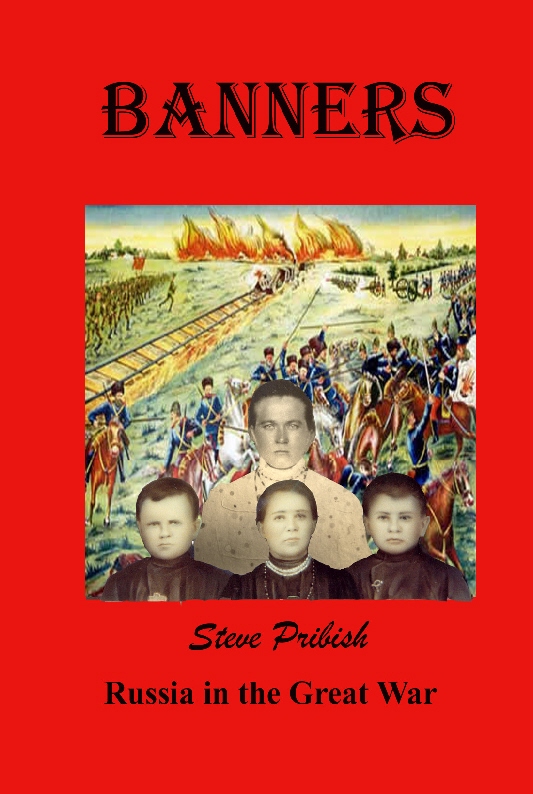
Buoyed by my new found confidence, I designed my own book cover.  All my covers were to have my ancestors' images.  The first reflected Massey and Akulina, who were the major characters, and the second contained Akulina and her sons, Stefan and John.  I knew how to use Photoshop, so what could be the problem?  All I had to do was cut my characters from the family portrait and slap them on various backgrounds.


Cover using the newspaper image background


Cover using refugee background
Cover using battle background

My focus group suggested using the cover with the battle background, but changing the subtitle.  I finally chose For God, Tsar and Russia, believing it conveyed the nature of the story.  iUniverse was more than happy to use it.

Banners back cover
For the back cover I changed my author's photo.  For this one, I went with a picture of me sitting in the cab of a Soviet missile launch system.  This is what I look like.

Me in the cab of one the Russian missile launchers we destroyed

I entered Banners in the Writers' Digest Self-Published Book Contest in 2003.  The book received fours and fives in all categories but cover design, which received a one out of five.  The reviewer remarked that while my prose was almost poetic, my cover looked like, "a Photoshopped picture on a background."  Which it was.  Another lesson learned.