Showing posts with label Marko. Show all posts

Saturday, January 28, 2017

Shout Outs

I had been repeatedly warned that using contemporaries in my stories was skating on thin ice.  By doing so, I was leaving myself open to law suits, which in the United States is no trivial matter.  However like most of my impulsive endeavors, I failed to heed this sound advise.  In today's post, I chose to give shout-outs to three individuals whose names and likenesses became character models.  So far, neither they nor their descendants have initiated legal proceedings.  Probably, because they didn't believe I would actually finish my project.

Korin Meshanko

Korin Meshanko was a chemical engineer employed by my old organization.  She was the ultimate scripted female who could hold her own in a male dominated profession or remain unfazed in an Outback pub.  During a trip to Australia in 1988, I passed the arduous flight enthralling her for 36 hours outlining my ideas for a book based on my family story.  For a counterstroke, Korin regaled me with the history of grandmother's life as an immigrant from Lithuania.
Korin enjoying a brew with Mavis and Spuds in Pimba SA
Korin's physical attributes, personality, and stories inspired the framework upon which I constructed the fictional Korin and Marko's shipboard romance while transiting the Atlantic.
* * * 

Korin would stand alone by the rail watching the sea, her blond hair tangled from the wind.  She did not wear her hair braided as the others, nor did she keep it covered.  Instead, she wore the scarf over her shoulders and allowed her hair to flow free. 
* * * 
I never did get any feedback on her impressions of my Korin character.  My guess is she never read her complementary copy of Ikons: Saint Nicholas the Wonder Worker.

Nicholas Troyan

In 1989 I was temporarily assigned to an OSIA (On Site Inspection Agency) team verifying the destruction of Soviet intermediate range, nuclear missiles. My team leader was LTC Nicholas Troyan, United States Army.  During our month long deployment to a Soviet missile facility,  Colonel Troyan and I discovered our mutual Russian heritage.  His grandfather had been an officer in the Tsar's Army and later fought for the White forces before escaping with Wrangel from Odessa.    
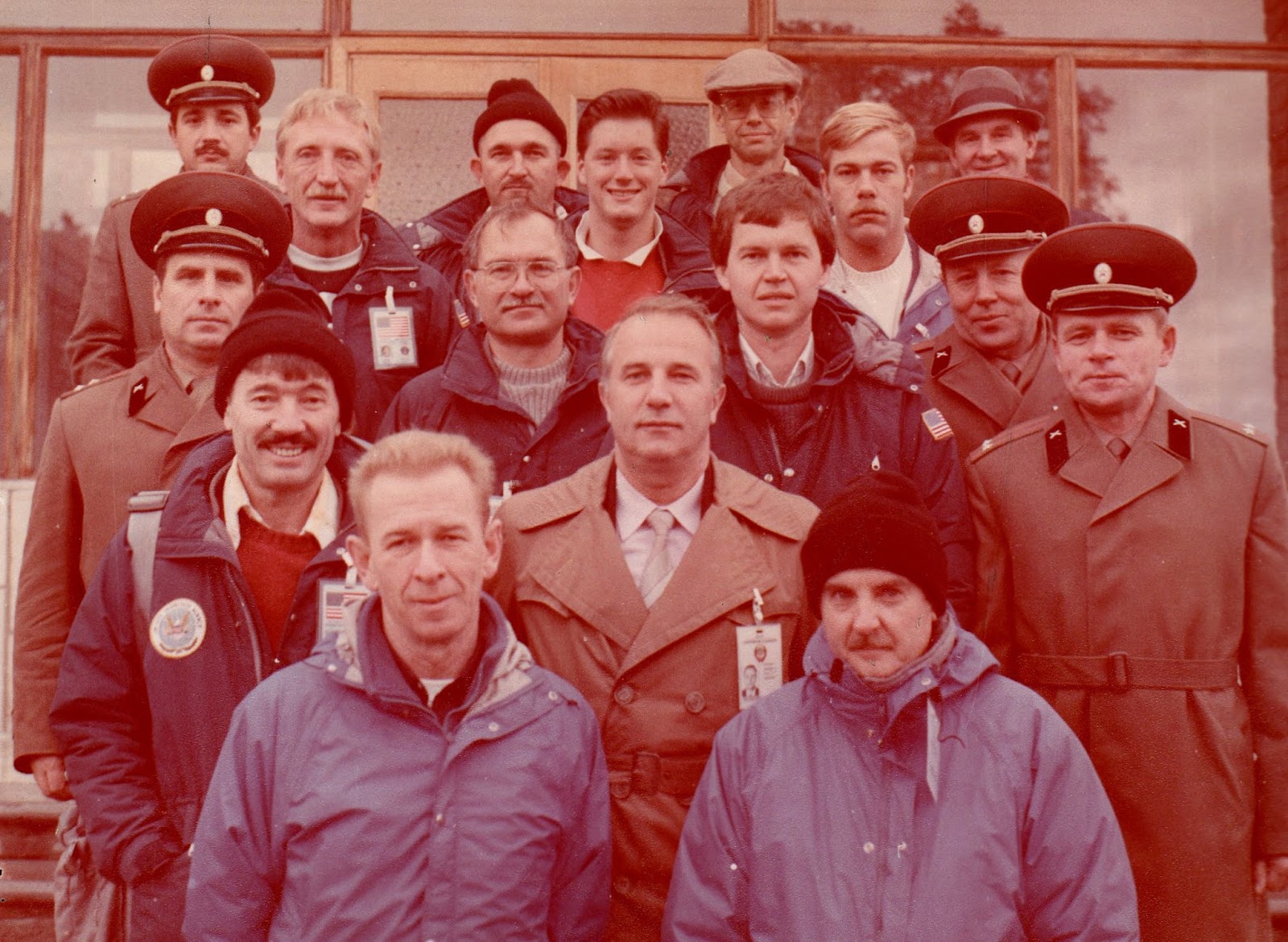
CFE Team Ruppert - Kosova, Belarus (Lt-Col Troyan First Row, Left)
Colonel Troyan was cut from the same cloth as Oliver North.  His brash attitude assured elimination procedures were completed by the book.  My character, who shares Troyan's name, attributes and rank, appeared in Banners: For God, Tsar and Country, and was one of my more colorful creations.
 * * *
The years had etched deep lines on his angular face, and his hair, although thinner and cut in the Prussian manner, still had the same sandy hue.  But instead of an eager, young pod-poruchik, Nikki now wore the three, five-pointed stars of a pod-polkovnik, a lieutenant colonel.

* * *
My Russian assignments introduced me to several Russians whose ancestors had remained.  Their tales were also incorporated into my saga.  During one of our chats, my Russian host pulled me aside and whispered, "When you return to America, kneel at your grandfather's grave and thank him for leaving his homeland."  I did.

Sheriff Joe Snedic

In a village like Rockdale, people were know by their occupations.  My father was "Steve the Barber" and my pal Buddy's father was "Bill the Bartender."  We also had "Tom the Grocer" and "Tony the Mayor."  The character I plucked from my childhood in the 50's and flung back thirty years was "Joe the Cop."
Sheriff Snedic inspecting the latest life-saving apparatus
Sheriff Joseph Snedic was Rockdale's law.  To us ten-year-olds, he was larger than life, patrolling the village and sometimes wailing his siren just to give us a start.  In Slogans: Our Children, Our Future, Joe got to play the part of a real detective.
* * *

Sheriff Joe Snedic entered the Rockdale mayor's office tapping the cover of his notebook.  “I got your answer, Tony.  That Pribish fella was right.”  The mayor's request was something quite different from the usual drunk and disorderly cases the sheriff normally pursued.  In fact, Joe was originally reluctant to even try his hand at a real police investigation based on Massey’s tip, but in the last few days he believed his results would have done Sherlock Holmes proud.
* * *
 Never underestimate the investigative prowess of a small town cop.  Thanks Joe.

Friday, December 30, 2016

Going to America

In my first novel, Ikons: Saint Nicholas the Wonder Worker, I describe my grandfather Massey's voyage to America: how he disembarked from the port city of Danzig aboard the SS Arabia, endured seasickness and indecision, and finally the dehumanizing experience of Ellis Island.  His journey was a tale fraught with danger, new friendships, romance and hope.

Danzig

My impression of the SS ARABIA in Danzig
I had Massey leave for America aboard the SS ARABIA, a converted British troop ship.  There was no such ship, but I liked the idea of placing the immigrants in the worse possible facility
* * *
 As the procession rounded the corner to the gangplank Massey suddenly came face to face with the SS ARABIA.  It was massive.  To his mind it was larger than any ship could possibly be.  Its whiteness shouted out against the gray overcast sky, her masts and funnels disappeared into the murkiness high above, and her deck spanned the horizon.  For a moment Massey stood frozen in awe.
 * * *
I gave my poor grandfather a bad case of seasickness, threw in the origins of his life long friendship with two Polish gentlemen and added a shipboard romance for good measure.  There was quite a bit of uneasiness as their ship approached America, each man wondering if he would be admitted or sent back in disgrace.

Ellis Island

 Ellis Island, the gateway to America.  Even though I had no proof, I sent Massey to Ellis Island.  After all, it was the port of entry for millions of Europeans during the early 1900's.  Following several weeks at sea, the passengers of the ARABIA were straining to catch a glimpse of the new world, their new home.
***
Eyes strained from every viewing point to catch a glimpse of the lady with the lamp.  For days, weeks, and even years, the passengers had heard of the lady who stood in the harbor to welcome immigrants to America.  But try as they might, their eyes could not pierce the gray mist shrouding New York Harbor.  The sun drenched sky that had greeted the ARABIA that morning had steadily clouded over as the ship moved west.  By the time she had reached the three-mile limit the sky had turned dark gray and a solid drizzle was falling.
 * * *
Ellis Island - Circa 1907
From mountains of background information, I constructed a plausible story of Massey's experience passing through Ellis Island.  I had him prodded, questioned, examined, interviewed and finally having his first American meal of eggs, bread, coffee and a banana.

Truth

Well, all this made a very nice story, but it never happened.  A decade after I published Ikons, I received an email for a woman whose grandfather accompanied Massey from Hutava.  According to her, my grandfather was part of a group that left their village for America in 1907.  Their destination was not New York's Ellis Island, but Baltimore's Locust Point.  Her family remained in Baltimore, but the others scattered, with Massey ending up in Rockdale Illinois.  
 
Baltimore Point of Entry in Its Heyday
So even though my version of Massey's first trip across the Atlantic is more fiction than history, it served as a source for an additional piece of our family's puzzle.