Showing posts with label Slogans. Show all posts

Friday, November 25, 2016

Music In Historic Novels


Russian Music

From folk songs to symphonies, from lullabies to  ballets, Russia's soul is expressed in her music. I used several references to music to immerse the reader in my stories.  During Akulina and Massey's wedding feast described in Ikons: Saint Nicholas the Wonder Worker, the hall was fill with boisterous melodies shouted by the celebrants.  Akulina sat stoically through the vodka infused celebration until Massey requested the manly Cossack tune, "Stefan Razin."  That did it.  Using her newly acquired wifely authority she whispered, "Not that. Sing 'Little Bells.'"  Massey realizing the shift in family dynamics acquiesced and called for the sentimental tune, which today is still considered by many the most beautiful Russian song ever penned.
Little Bells

I used the haunting lyrics of "Little Bells" throughout my three novels whenever one of my characters would leave their homeland.  It continued until the ultimate departure, the death of Boris.

Patriotic Music

Banners: For God, Tsar and Russia begins with the citizens of Hutava sending her sons off to battle accompanied by the stirring notes of a popular patriotic song, "Sing Little Nightingale." The villagers, led by old Telepnev's concertina, made up in volume what they lacked in tone.  The rousing melody and festive atmosphere belied the disaster awaiting Hutava.
 
Sing Little Nightingale

After three years and millions of casualties, Russia's music shifted from patriotic to revolutionary.  By 1917 her citizens paraded with a different song on their lips -- "The International."  This clip from the 1981 movie "Reds" captures the heady optimism of the Russian Revolution when a socialistic future still held great promise.  In my third book, Slogans: Our Children, Our Future, young Stepha learns to play "The International" on his concertina and leads "volunteers" to the planting and harvest.
The International
The new government is not embraced by all thrusting Russia into civil war.  As Reds and White forces clash, another song replaced "The International."

Song of the Red Army

Kataya's childhood friend Igor was conscripted into the Red Army and became an officer in the Konarmia, the feared Red Calvary.  With Igor in the vanguard, the Konarmia cut a swath through enemy forces until its defeat on the banks of Vistula. 
White Army, Black Baron
The military song, "White Army, Black Baron," was sang by the Komarmia during their march and heralded the coming of their 100,000 sabers as a challenge to all who opposed them.

Popular songs are sprinkled throughout my saga as the situation requires.  The strains of the gypsy melody "Dark Eyes" brought memories of home to the Russian immigrants in America, and the Subboniks defiantly sang the "Song of the Volga Boatmen" during their forced labor.  Stepha learned several melodies on his concertina with "My Little Duck" being his signature tune.

The boastful lyrics of George Cohan's "Over There" announced America's entry into the first world war and those of the melancholy "The Long Long Trail" its departure.

Tuesday, November 8, 2016

Characters With Extreme Passion

On a sunny January morning in 1905, thousands of Russian citizens marched toward the Tsar's Winter Palace.  The unarmed marchers were there to present a petition asking their Little Father to right the wrongs of his people.  As the marchers neared the palace, they were met with hundreds of sword-wielding Cossack bent on preserving order.  In the ensuing attack, hundreds of marchers were killed and hundreds more wounded.  The event became etched in Russia's soul as Bloody Sunday.
Bloody Sunday
Eleven years later, the populous of Petrograd, pushed beyond tolerance and filled with courage spawned by desperation, again marched against the Tsar's government.  Their demand was simple - food.  In my novel, Banners: For God, Tsar and Russia, the story of this event is told through the actions of Valentina Kondakova.
* * *
When twenty-year-old Valentina Kondakova left her tenement in the Vyborg district of Petrograd, she did not intend to bring down a government.  All she wanted was to participate in the International Woman’s Day and demonstrate for bread and justice.
* *  *

Women's Day Protest for Bread and Justice
I created Valentina to represent those caught up in historic events.  Valentia was not a fiery radical, but a simple worker who found courage in necessity and numbers.  She and the other women from the Neva Thread Mills Workers' Soviet were among those who unfurled their banners and began a determined march toward the Winter Place and destiny.  What lay before them could have become another Bloody Sunday.
* * *   

Valentina could not stop now if she wanted.  The crush of the women behind her forced her forward and even the fierce sound emanating from the soldiers could not stem their advance.  Valentina had resigned herself to die, but then understood the soldiers weren’t taunting―they were cheering.   

“Keep coming, sisters,” one shouted.  “Press harder,” yelled another.  Soon all the shouts blended into one single, irresistible chant, “Freedom!  Freedom!  Freedom!”  The powder keg had exploded.

* * *
While I never participated in a demonstration, as did Valentina, I vicariously experienced the anti-war marches of the sixties and the outpour of hatred against George Bush in the early part of this century.  I found it easy to write from Valentia's desperate resolve, but I hesitated to attempt the vitriolic attacks exhibited by individual activists and such organizations as Code Pink.  I simply could not find the words to convey my characters raw hatred.
A century later, demonstrations continue
Early in Banners, I introduced a Cossack named Alexander Dukov, who progressively became an ardent and passionate Communist.  I was never comfortable with Sasha, for his single-minded dedication to a cause was foreign to me.  I always see two sides to a story and cannot embrace the concept of total righteousness.  Writing from Sasha's point of view stretched my imagination.
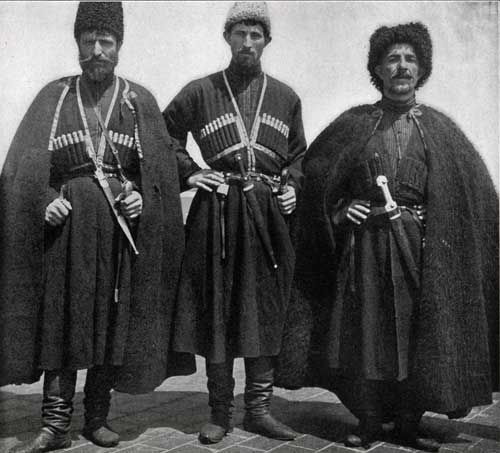
Cossack
* * *

“No!”  Sasha hammered his fist into the table.  “We can’t allow any of them to escape.  We must crush them like the bugs they are.  We should level the palace and kill them all.  It will be a lesson to anyone who stands before the will of the people.”

Cossacks.  Can’t anyone tame them?
* * *

My other character in the demonstration scene was modeled after a military friend of mine.  The young officer I penned faced a dilemma.  Does he fire one women who could well be his sisters or does he follow his orders?

* * *

“Tell the men to lower their weapons and stand down,” commanded Shatbs-kapitan Guddenov.  It took a moment for the noncoms to realize his meaning before they passed it on.  At first the company greeted the command with stunned silence, then suddenly a spontaneous cheer rose from the ranks."

* * *
When I presented the scene to friend, he disagreed with my character's action.  He claimed he would have followed orders to halt the marchers by any means necessary.  I hope he was joking.

Monday, February 29, 2016

There Will Be Crosses


In the spring of 1997,the Dayton Daily News premiered their annual short story contest.  My novel had been plodding along well into the era of the Great War.  Three of my chapters told the story of Massey's friend, Ribba, fighting against the Austrians during the siege of Przemysk, in what was then Austrian-Poland.
Short Story Winner - 1997
The characters and plot were ideal for a short story -- infantrymen wait in their trenches for what they believe will be their final battle.  The banter and comradeship between the men transcends nationality making for an emotional tale.  My short story differs from the novel in location and characters.  Instead of the Eastern Front, the battle takes place in France and the characters are not Russian, but Americans in an Afro-American company.  While fictional, this episode is based on historic facts and could have occurred.

Men of Bronze during the Great War
In rewriting this story, I stayed away from using what could be called Black dialect. Instead, I gave my characters Southern  nicknames suggested by a Texan coworker.  Thus I had Crawdad, Polly, Cajun, Preacher, and Cricket.  I used slang from World War One throughout the story.  Paul Dickson published a very detailed dictionary of the history of American military slang, called War Slang: American Fighting Words and Phases from the Civil War to the Gulf War.  Many readers congratulated me on capturing my characters' voices when they mistook war slang for black dialect.

I titled my story There Will Be Crosses.  As with Ikons and Banners, crosses were the theme running throughout the story.  It begins with the cross Crawdad wears for luck, to the crosses hanging from the medals they know they will never receive, to the the crosses placed upon their graves far away from home, and finally the cross as a sign of life.

Not only did I win a nice dollar amount for my story, which went toward publishing my books, but it also gave me confidence to continue writing. Winning against professionals reinforced my desire to finish my dream.

Interested readers can find There Will Be Crosses at www.flyingbrickvideo.com

Thursday, February 18, 2016

Selling Ikons: Saint Nicholas the Wonder Worker

Along with my shipment of novels, iUniverse supplied digital press and sales kits.  The press kit consisted of sample news releases, sell sheets, and suggestions for getting my book noticed by the media.  The sales kit included pdf files for printing posters, book marks, and post cards announcing the publishing of Ikons.  Armed with this arsenal of material I set out in earnest to publicize my work.

My first targets were friends and relatives, which actually netted sales.  After depleting that resource, in short order I was forced to take a more traditional rout.  Book stores at this time had not yet been inundated by indie writers looking for shelf space and I was fortunate enough to have a few Mom and Pop stores agree to carry Ikons.  It was at this point I found out I made a grave mistake with my title.

 Ikon of Saint Nicholas the Wonder Worker
While the name "Ikons" was well thought out (Humor me) the subtitle wasn't. Saint Nicholas the Wonder Worker turned out to be a bad idea.  While I understood the significance of the sub-title, few others did.  Of the indie book stores I talked into displaying Ikons, one ended up placing Ikons in the religious section.  A buyer tracked me down and informed me of such.  He didn't want his money back, just wanted me to know.


My space at the Joliet Author Fair
My nest step was an author fair and I secured at spot at the Public Library's in Joliet, Illinois.  Since my story took place in Joliet's suburb of Rockdale, it was a prime spot.  I sent a sell sheet to the local paper and a letter detailing my story and how it related to the area.  A reporter from the paper called and interviewed me and did an article for the local section called, "From Russia to Rockdale."

In addition to book sales, I met the renown indie writer J. A. Konrath who gave me tips on selling self-published books.  Check out his site after reading mine.

Book Club "Meet the Author"


Even better was a woman who bought my novel and later suggested it to her book club.  She invited me to speaking engagement and do a signing.  I agreed and was surprised to find her club met at the village recreation center.  They had decorated the room in a Russian motif and offered a wine and cheese spread.  I gave my talk, sold my books, and was quite impressed.  My ego had definitely been stroked.


Book Club "Meet the Author" display i
The Book Mouse in Ottawa, Illinois

                                                                        My next stop was a small book store in Ottawa, Illinois, the Book Mouse.  There I did another meet and greet, told my stories, topping it off with my ghostly tale of the Voltuno.  My sales were not overly impressive, but the crowd was receptive and I think a good time was had by all, or at least enough.


Display at the Book Mouse


The next venues were the local author event with Dayton Metro Library and later the Dayton Book Expo.  Both events were open to authors residing in the Southwest Ohio area, but there was a limit to the number of authors who could participate.  My previous video productions for the library got me a prime spot.  I attracted a crowd by giving away old VHS tapes of programs I had created.  The lure of free stuff, no matter how useless, still attracts a crowd.
Book Expo - Dayton, Ohio
Book Expo display

Each stop was another opportunity to sell books and spread my fame.  I believed I was actually getting the hang of this author stuff.